 Glint
Your plan
A little every day
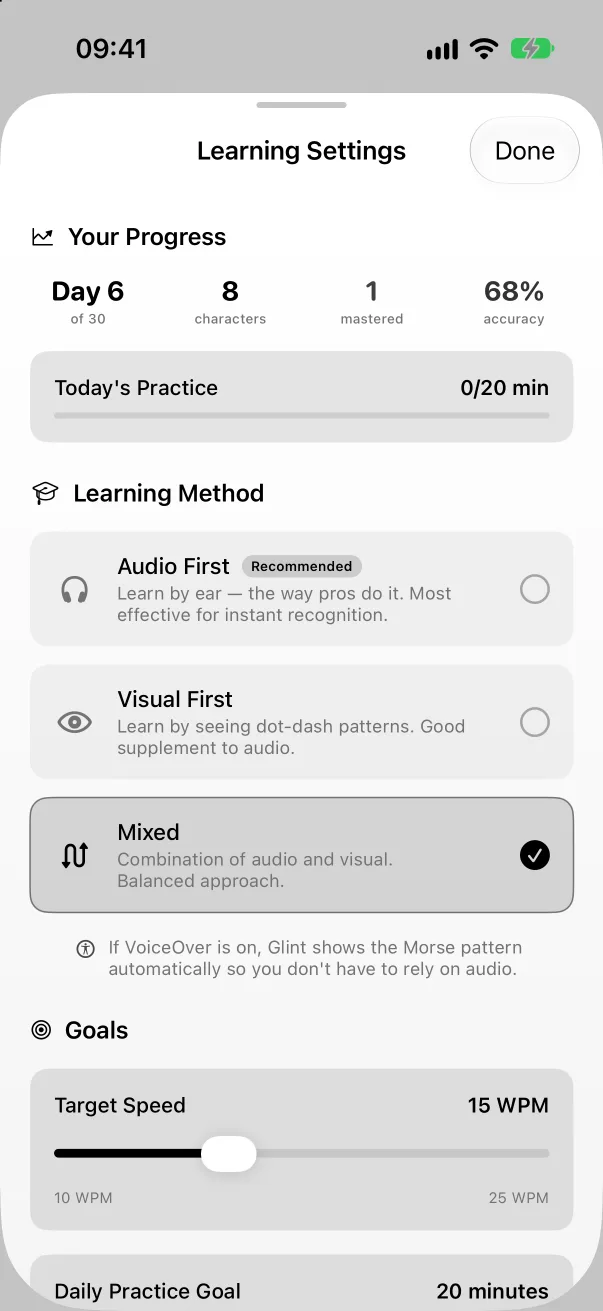
Glint sets a daily practice goal and a target speed, and tracks your streak and your accuracy for every character. Choose how you learn: audio first, which is how the fast operators do it, visual first, or a mix.
The course
Skip the chart. Learn the sounds, a couple at a time. Your first minute starts here: listen, then tap it back.
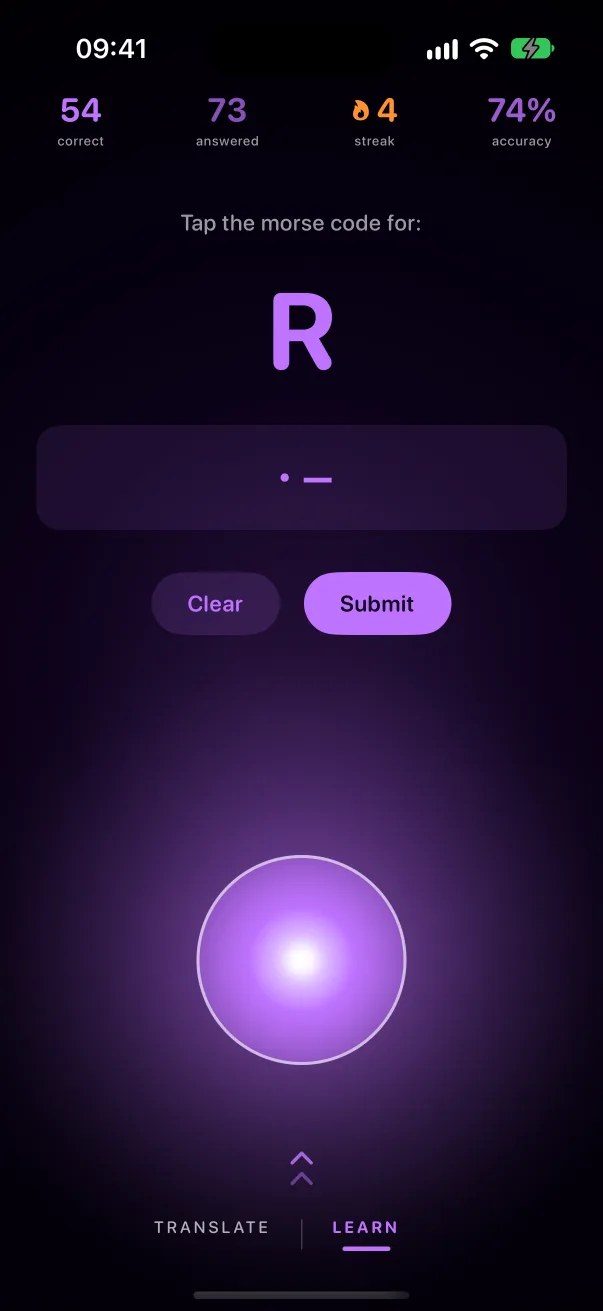
Tap the Morse code for:
E
E is one dot. The shortest letter there is.

Glint teaches the rest.
Most people start by memorising a table: A is dot dash, B is dash dot dot dot. It feels like progress and then it stalls. You hear a letter, count its dots and dashes, look up the answer in your head, and miss the next two letters while you do it. Counting breaks down as soon as the code speeds up.
Operators who are fast do not count. They hear · − as one sound, as you hear a whole word. So learn each character as a rhythm from the first day.
This is the Koch method, named after the psychologist who tested it on trainee radio operators. You begin with a couple of characters sent at your target speed. Once you get nearly all of them right, you add another. Then another. It feels slow for the first week and fast after that, because nothing you have learnt needs replacing.
If full speed is too much at first, keep the characters fast and stretch the silence between them. That is Farnsworth timing. You still learn the real sound of each letter and you get more time to think.
Your plan
Glint sets a daily practice goal and a target speed, and tracks your streak and your accuracy for every character. Choose how you learn: audio first, which is how the fast operators do it, visual first, or a mix.
Hands-free
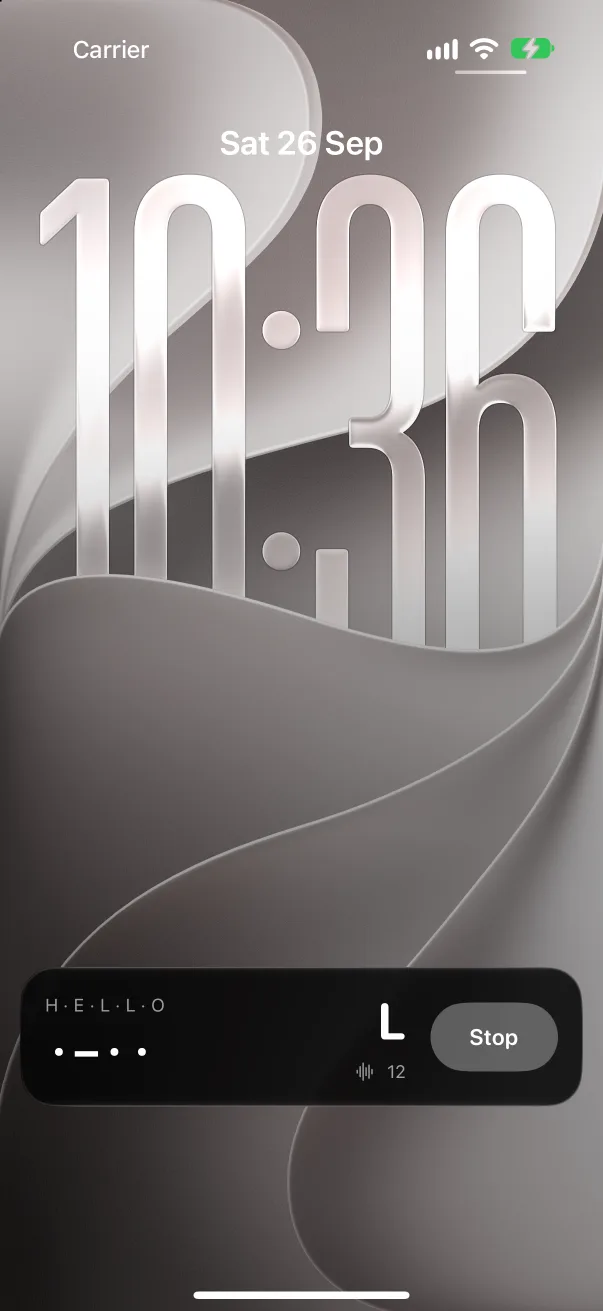
Glint drills your weak letters by ear while the phone stays in your pocket. Walks and commutes count. The Lock Screen shows what is playing and lets you stop it.
Tapping a letter out fixes it in memory faster than hearing it alone. Use the key: a short tap for a dot, a longer hold for a dash, and a pause to finish the letter.
A knock cannot be held, so tapped Morse uses the pauses instead: a short gap after a dot and a longer one after a dash. Blinking and flashlight signals work like sound, short and long. Whatever you use, keep the ratio: a dash is three dots long.
Begin with their name and with SOS. Tap it on the table. Flash it with a flashlight after dark. A few minutes as a game is enough.
Learn it by ear at full speed, a couple of characters at first, and add one more whenever you are getting nearly all of them right. This is the Koch method. A short session every day works better than one long session a week.
Hours, not months, if you learn by ear and practise a little every day. That is what Glint's course is built around.
By sound. If you memorise a chart you end up counting dots and dashes, which stops working once the code speeds up. Learn each character as a rhythm and there is nothing to unlearn.
Yes. Start with their name and SOS, tap it on the table, and flash it with a flashlight after dark. Short games work better than drills.
Glint is free on the App Store, for iPhone.